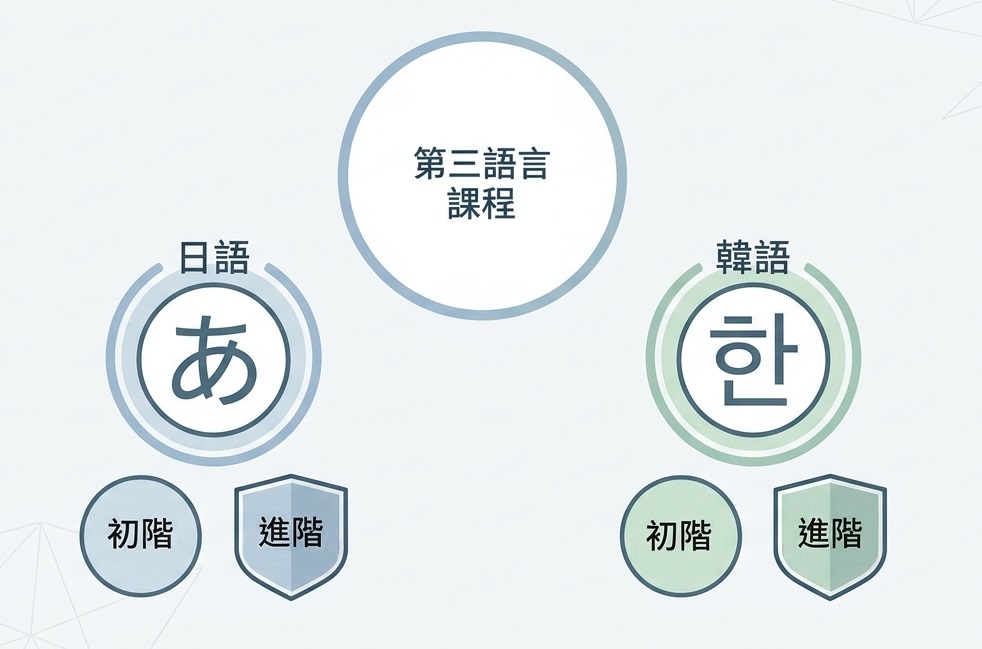
A. Junior Secondary School curriculum
Subjects
Chinese, English, Mathematics, Citizenship, Economics and Society, Geography, History, Science, Information Technology, Chinese History, Putonghua, Music, Home Economics, Design and Technology, Visual Arts, Physical Education, and Accounting and Business Management.
Curriculum Philosophy
• Emphasis on language training: to lay a solid foundation in Chinese and English. Subjects taught in English include Geography and Information Technology, so as to strengthen students’ language foundation.
• Emphasis on computational skills and logical thinking: Mathematics.
• Emphasis on thinking skills and critical thinking: Citizenship, and Economics and Society.
• Emphasis on academic and knowledge enrichment: Chinese History, Geography, etc.
• Other subjects: knowledge acquisition, skills training, physical training and arts appreciation, etc.
B. Senior Secondary School Curriculum
• Compulsory subjects: Chinese, English, Mathematics, and Citizenship and Social Development.
• Elective subjects: Chinese History, History, Geography, Economics, Business, Accounting and Financial Studies (BAFS), Information and Communication Technology (ICT), Physics, Chemistry, Biology, Algebra and Calculus, Tourism and Hospitality Studies, and Visual Arts.
[Students choose three elective subjects.]
Students in Secondary 5 and Secondary 6 may reduce their electives to two subjects. Students who do so will, as far as possible, be arranged to attend special enhancement classes in Chinese, English and Mathematics to strengthen their foundation and examination techniques.
• Music Appreciation, Arts Appreciation, Physical Education, and Moral and Civic Education.
C. Learning
• Emphasis is placed on developing students’ biliterate and trilingual proficiency;
• Diversified teaching modes are adopted to increase classroom interaction and enhance students’ interest in learning. Students are also encouraged to engage in self-learning, active learning and independent learning;
• Students are encouraged to take the initiative to ask questions, take notes and deliver classroom presentations / performances;
• Emphasis is placed on balanced and comprehensive learning, with equal weight given to the arts, sciences and technology. School-based curricula are actively developed in the junior secondary years, such as Business, Accounting and Financial Studies.
D. Teaching
• Subject teachers work closely together and engage in regular professional exchange so as to adjust the curriculum, teaching progress and set examination papers;
• Apart from Chinese, English and Mathematics, which adopt streaming in different forms, all subjects take learning diversity into account in both curriculum design and classroom teaching. For Chinese, English and Mathematics, one period per cycle is arranged for teachers teaching the same subject at the same level to conduct collaborative lesson planning and exchange. Teachers of other levels and subjects are also encouraged to increase opportunities for collaborative lesson planning and professional exchange.
• Teaching foci, strategies and supporting materials (such as notes, worksheets, online self-learning and discussion materials) are revised annually in light of students’ progress and societal needs;
• Emphasis is placed on teachers’ professional development. Efforts are made to implement individual professional development plans for teachers, lesson study, collaborative lesson planning, peer lesson observation, cross-curricular collaboration and inter-school (local and overseas) teaching sharing.
E. Pedagogy / Teaching Strategies
• Interactive, student-initiated questioning, inquiry-based and issue-based teaching approaches are adopted;
• Students are guided to participate actively in lessons and all learning activities;
• Critical thinking and multi-perspective thinking are employed. Building on a solid knowledge foundation, students analyse and comment on issues, accommodate different views and values, and conduct rational discussion based on sound reasoning;
• Teachers must have a thorough understanding of the marking criteria for data-response questions and extended-response questions, and guide students to master answering techniques and strategies for gaining marks;
• Teaching routines are optimised through the implementation of the “Four-Step Classroom Approach”: in every topic / lesson, teachers present clear learning objectives, check pre-lesson preparation, conduct diversified teaching, and provide a classroom summary.
F. Assessment
• Format: Assessment items should follow the requirements of public examinations and focus primarily on knowledge, understanding, analysis, data response and extended response.
• Types: Emphasis is placed on continuous assessment, including worksheets, assignments, tests, learning journals and examinations.
G. Assessment for Learning
Assessment for Learning
• Continuous assessment: Learning routines (in-class and lesson summary: questioning, feedback and reflection)
• Summative assessment: Post-examination evaluation forms; review and follow-up after each assessment
H. Assessment and Development
Followed up by the Learning Development Team:
1. Plans for promoting learning formulated by each subject (P)
2. Implementation status of each subject (I)
3. Review and follow-up of each subject (E)
Strengthening Assessment for Learning (CDC, 2002, Basic Education Curriculum Guide, p. 1)
“Teachers should provide timely feedback through assessment in daily classroom teaching so that students can more readily grasp the key learning points. The focus of assessment should be placed on identifying the reasons for students’ learning difficulties and how to help them improve, rather than merely determining what knowledge students have acquired.”
“In the process of learning and teaching, teachers should identify and diagnose the difficulties encountered by students in learning, and thereby provide effective feedback.”